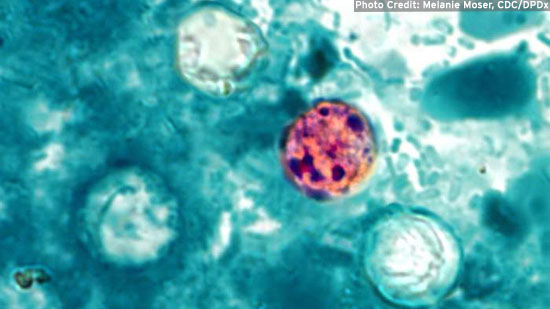
Cyclospora

At Ecolab, we partner with customers to help keep their operations clean, safe and healthy by protecting people and the resources vital to life. We work to support food safety and infection prevention efforts across customer operations. 

Read on to learn what Cyclospora is, how it spreads, what public health authorities recommend, and steps you can take to help reduce risk.

Download Cyclospora Readiness Kits

WHAT IS CYCLOSPORA?

Cyclospora cayetanensis, or more commonly referred to as Cyclospora, is a microscopic parasite that infects the small intestine and causes cyclosporiasis. Cyclosporiasis is a nationally notifiable disease in the United States. Cases occur every year, with most illnesses reported between May and August. Although Cyclospora was historically associated with travel to tropical and subtropical regions and imported produce, recent outbreaks have increasingly been linked to domestically grown fresh produce.1,2

Fresh produce identified as vehicles of transmission during outbreaks has included raspberries, basil, snow peas, cilantro, bagged salad mixes, and romaine lettuce. In 2018, multiple outbreaks were linked to romaine lettuce produced in the United States, marking an important shift from previous outbreaks associated primarily with imported produce.1,2

Cyclospora continues to be a significant produce safety concern. US FDA and US CDC investigations have identified recurring seasonal outbreaks associated with fresh produce, and in recent years several thousand domestically acquired cases have been reported in the United States. In 2026, CDC reported 145 domestically acquired cases across 17 states by mid-June, highlighting the ongoing public health importance of this parasite.1,2

WHAT ARE THE SYMPTOMS?

Symptoms typically begin about one week after exposure but can range anywhere from two days to two weeks. Common symptoms include:

  • Watery diarrhea, sometimes explosive
  • Loss of appetite
  • Weight loss
  • Abdominal cramping and bloating
  • Nausea
  • Fatigue
  • Low-grade fever and vomiting (less common)

Without treatment, illness may persist for several weeks or longer and can follow a relapsing-remitting pattern.4

HOW IS IT TRANSMITTED?

Cyclospora is spread through ingestion of food or water contaminated with human feces containing infective oocysts. Person-to-person transmission is unlikely because oocysts shed in feces are not immediately infectious.

After shedding, oocysts typically require 1–2 weeks in the environment to sporulate and become infectious.3,4

HOW IS IT CONTROLLED?

Cyclospora oocysts are resistant to many commonly used disinfectants. There are currently no EPA-approved efficacy protocols or registered product claims for Cyclospora, making prevention of contamination the primary control strategy.3,5

Contamination often occurs before harvest, therefore agricultural water quality, worker hygiene, and sanitation practices are critical preventive controls.1,3 Key prevention measures include:

  • Following Good Agricultural Practices (GAPs) including:
    • Monitoring agricultural water quality
    • Maintaining worker health and hygiene programs such as
      • Illness reporting and exclusion
      • Access to portable restrooms
      • Access to handwash stations
    • Preventing contamination from human fecal sources
  • If in the US or importing to the US, follow FSMA Produce Safety Rule requirements
  • Washing produce may help reduce contamination but should not be relied upon to eliminate Cyclospora risk.3,5

For manufacturing, retail, and food service establishments, Cyclospora prevention strategies center around supplier verification and record keeping. Strategies include:

  • Sourcing produce from approved suppliers
  • Maintaining product traceability and lot-code records for rapid recall and outbreak response
  • Thoroughly washing fresh produce before use
  • Maintaining proper cleaning and sanitizing to prevent cross-contamination

For more information, contact your Ecolab representative or visit ecolab.com/contact-us.

REFERENCES AND FURTHER INFORMATION

  1. US Food & Drug Administration (FDA). Cyclospora Prevention, Response and Research Action Plan. (2021, July 1). [FDA.gov – Action Plan]
  2. US Centers for Disease Control and Prevention (CDC). Surveillance of Cyclosporiasis. (2026, July 1). [CDC.gov – Surveillance]
  3. US Food & Drug Administration (FDA). Cyclosporiasis and Fresh Produce: An Overview of Cyclospora cayetanensis for Farmers. (2022, July). [FDA.gov – Fresh Produce]
  4. US Centers for Disease Control and Prevention (CDC). Clinical Overview of Cyclosporiasis. (2024, March 4). [CDC.gov – Overview]
  5. US Centers for Disease Control and Prevention (CDC). Preventing Cyclosporiasis. (2024, February 29). [CDC.gov – Prevention]
  6. Hall R.L., Jones J.L., Herwaldt B.L. Surveillance for laboratory-confirmed sporadic cases of cyclosporiasis—United States, 1997–2008. MMWR. 2011;60(2):1–11.

Get In Touch with Us

Give Us a Call

With unparalleled expertise and cutting-edge technology, we partner with customers to deliver world-class results and optimized operations. Contact us to learn how we can help you.

Ecolab Inc.
1 Ecolab Place
St. Paul, MN 55102

Ecolab Customer Service: 
Phone: +1-800-352-5326

Nalco Water Customer Service
Phone: +1-800-288-0879

Contact Us

 Please complete this form or give us a call at +1-800-352-5326 to connect with Customer Service.